Your cart

Product Title
Option 1 / Option 2 / Option 3
Product Note
Subscription Plan Info
Product Discount (-$0)
COUPON1 (-$0)
$0
$0
-
+
Your cart is currently empty.
Enter discount code
Thank you! Your submission has been received!
Oops! Something went wrong while submitting the form.
Coupon1
Coupon2
Cart note
Subtotal
$0
COUPON2
-$0
Order Discount
-$0
Cart Total
$0

Power In the Blood

“Indeed, under the law almost everything is purified with blood, and without the shedding of blood there is no forgiveness of sins” (Hebrews 9:22 ESV). Why is the grotesque and evil act of the crucifixion of Jesus Christ, a sinless man who was brutally sacrificed, the full display of God’s love for humanity? Why would such a bloody death be necessary for you to be saved and avoid hell? What difference does his blood make to you in living a powerful life? The Bible tells us.

Power In the Blood

“Indeed, under the law almost everything is purified with blood, and without the shedding of blood there is no forgiveness of sins” (Hebrews 9:22 ESV). Why is the grotesque and evil act of the crucifixion of Jesus Christ, a sinless man who was brutally sacrificed, the full display of God’s love for humanity? Why would such a bloody death be necessary for you to be saved and avoid hell? What difference does his blood make to you in living a powerful life? The Bible tells us.
Why Blood? 

Blood is precious—it has the power to give and sustain life, it circulates through the body delivering oxygen, nutrients and hormones, and it purifies the body by flushing out carbon dioxide and impurities. Yet blood has an even greater power because it was shed by the Savior, Jesus Christ. It can cleanse our sins to make us worthy of a relationship with the living and holy God, who gives us everlasting life.

When it comes to discussing blood, some of us get a little squeamish. Entertainment at the local multiplex, or at home on Netflix or Hulu, is dominated by movies in shades of the living color: blood red. Bullets, knives, bombs and other weaponry destroy flesh before our eyes, and the drips, pools and splatters visually tell the story of death. Medical dramas deliver the red stuff with tight shots of a surgeon’s scalpel slicing through layers of abdominal tissue or a MacGyver-like doc clamping off gushers.

Our world is accustomed to seeing blood, and media investors are rewarded for showing it. Violence in films has more than doubled since 1950; the standards for an R-rating have progressively crept downward to PG-13. Even movie trailers are explicit. Yet The Passion of the Christ, the story of the twelve hours that led to the crucifixion of Jesus Christ, released in 2004, was criticized by some for excessive violence. Why?

There is no antiseptic way to tell the story of Jesus Christ’s death on the cross. He literally sweat blood in the Garden of Gethsemane (Luke 22:44), He shed blood from the crown of thorns being pushed into His scalp (Matthew 27:29) and His hands (wrists), feet and side (John 19:34) were pierced. It was bloody to fulfill Scripture, and law required a blood sacrifice so we could be cleansed, purified and accepted by God. Possibly it was the message behind the shed blood that asked moviegoers to make a decision—a hardened or changed heart—that was offensive.

Blood is central to the Christian message. At one time the church regularly included teachings on the blood sacrifice along with hymns and sermons. Revivalists of the past wrote such hymns as “Power in the Blood,” “Are You Washed in the Blood?” and “There is a Fountain Filled with Blood.” The words of William Cowper, English poet and hymnwriter, are direct and unapologetically to the point: “There is a fountain filled with blood drawn from Emmanuel’s veins; and sinners plunged beneath that flood lose all their guilty stains.” Its message of the saving power of the blood of Jesus Christ is grounded in Scripture. “On that day a fountain will be opened to the house of David and the inhabitants of Jerusalem, to cleanse them from sin and impurity” (Zechariah 13:1 NIV).

Ignoring the importance of the blood denies the truth and the power it provides. It’s like having a life-saving vaccine that you won’t offer to the suffering because of the pain the injection will cause.
Russell Moore, author and president of the Ethics & Religious Liberty Commission of the Southern Baptist Convention, writes “. . . bloodless Christianity leaves a void. Could it be that the lack of emphasis on blood in Evangelical Protestant churches at least partially explains why Baptists and Methodists and Pentecostals who otherwise would have little to do with Roman Catholic imagery found themselves openly weeping in movie theaters as they viewed The Passion of the Christ? Did they need to remember that “with His stripes we are healed” (Isaiah 53:5 KJV)?”

God is love. Everything He does exemplifies love. It is His desire that we are members of His family, His kindred. Kindred is an ancient word describing three special relationships: family by blood, family by marriage and family by adoption. Jesus’s sacrifice made a way for us to belong to God through His blood, through the covenant of eternal marriage and through the spirit of adoption. There is no other earthly relationship in which we can belong through all three special familial bonds.

We are made sons and daughters of the Most High King and joint heirs with Jesus through the shedding of His blood. Jesus laid down His life so you could be His forever brother or sister. God endured the pain of watching His Son die because He loves you. The cross of Christ is the invitation to be the kindred of God.

We often hear the phrase, as innocent as a baby. But Scripture tells us we are born sinners. We inherited Adam‘s original sin (remember the apple incident in Genesis 3?). Romans 5:12 ESV says, “Therefore, just as sin came into the world through one man, and death through sin, and so death spread to all men because all sinned.“

We may think of sin as just an annoyance— something that gets in the way of us being a good person. To God, though, our sin is an outright rebellion against all that is good, right and holy. The late English Baptist preacher Charles Spurgeon said, “It is not sin as we see it that was laid on Christ but sin as God sees it, not sin as our conscience feebly reveals it to us but sin as God beholds it in all its unmitigated malignity and unconcealed loathsomeness. Sin, in its exceeding sinfulness, Jesus has put away. But when we perceive sin, then we are to trust the blood.” God’s wrath burns hot against all sin. God’s perfect justice demands for the payment to be made. We have no way to pay the due penalty for our sin. There would never be enough we could give.

Sin is so egregious to God‘s law that the penalty for it is death. In the Old Testament, God requires sinners to make an animal sacrifice. This offers only a temporary atonement or covering of sin (Leviticus 4:35, 5:10). “Indeed, under the law almost everything is purified with blood, and without the shedding of blood there is no forgiveness of sins“ (Hebrews 9:22 ESV).

The Bible tells us the single offering of the blood of Jesus covers all our sins—past, present and future. The blood of bulls and goats could only do so much for so long. As blood served as a temporary substitute for external wrongs committed against God and others, it was ineffective to forgive the thoughts and intents of a person’s heart.

God sent His perfect Son to be crucified on a Roman cross to satisfy the payment for sin—once and for all. Jesus Christ was the only solution. He was fully human and fully God and because God is His biological Father, and not Adam, Jesus did not inherit a sin nature. Jesus was the perfect man and He lived a perfect, sinless life. His death and resurrection and His poured-out blood is so powerful that it provides sinners with a payment so great as to eradicate all sin for all mankind with only one requirement: to accept Him as Savior.

Throughout Scripture, blood is used as a method and reminder of God’s deliverance of His people when they are in trouble. God shows us that His care for us is close to His heart, His very being.

In the book of Exodus, Moses stands before Pharaoh, with the commands of God in his mouth, and demands the Israelites, stuck in slavery and bondage, be let go. Then God delivers them out of the hand of their enemy and into a land flowing with milk and honey. Because Pharaoh refuses to obey God, He punishes him with ten plagues of destruction. The tenth plague is the threat that every firstborn in the land will die. To deliver them from this plague, God tells the Israelites to sacrifice a lamb without blemish and spread its blood over the doorpost of their homes. “The blood shall be a sign for you, on the houses where you are. And when I see the blood, I will pass over you, and no plague will befall you to destroy you, when I strike the land of Egypt” (Exodus 12:13 ESV).

The Passover serves to show that blood is necessary to cover our sins, but there needed to be a more permanent solution than that of blood shed from goats and lambs. The solution is the Savior, Jesus Christ, as proclaimed by John the Baptist: “Behold, the Lamb of God, who takes away the sin of the world!” (John 1:29 KJV). Jesus, the unstained, unblemished, sinless and exalted King, offers His own blood once and for all (Hebrews 7:26–27). The blood of the lambs was a sign of deliverance from death on that one night, but the blood of Jesus over our lives is a sign of deliverance from eternal death.

Because the blood of Jesus has destroyed the power of sin over our lives, we are free to live in joy and obedience. Theologian and Episcopal priest Fleming Rutledge, author of The Crucifixion: Understanding the Death of Jesus Christ, says, “Christians do not simply look to the cross of Christ with prayerful reverence. We are set in motion by its power, energized by it, upheld by it, guaranteed by it, secured by it for the promised future.” We have been united with Christ in His death and consequently in His resurrection. The blood of Jesus gives us a new heart and a new spirit to freely live as fully forgiven.

When God gives us a new heart, old things—worldly desires, uncaring attitude toward sin and disinterest in the worship and holiness of God, to name a few—pass away. The new heart of a believer loves God and loves what He loves. Little by little, God renews our minds to think like He thinks (Romans 12:2), causes us to hate the sin we once loved (Romans 7:15–16), and awakens us a desire to look more like the God we worship (Romans 8:29). The blood of Jesus takes us as we are, yet loves us too much to leave us as we were.

His Body Broken For You; His Blood Poured Out For You

God consistently reminds His people to remember and He warns them to be aware of forgetfulness. “[T]hen take care,” God reminds His children through Moses, “lest you forget the LORD, who brought you out of the land of Egypt, out of the house of slavery” (Deuteronomy 6:12 ESV). This is more than forgetting to send a thank-you note; this is a group of people who fail to remember that God liberated them from slavery and bondage.

For believers, it’s imperative that we remember what God does for us. Every Christian practice that God commands is purposed to help us remember who God is and what He has done for us. Jesus instituted the Lord’s Supper to help us remember what the cross of Christ means for believers.

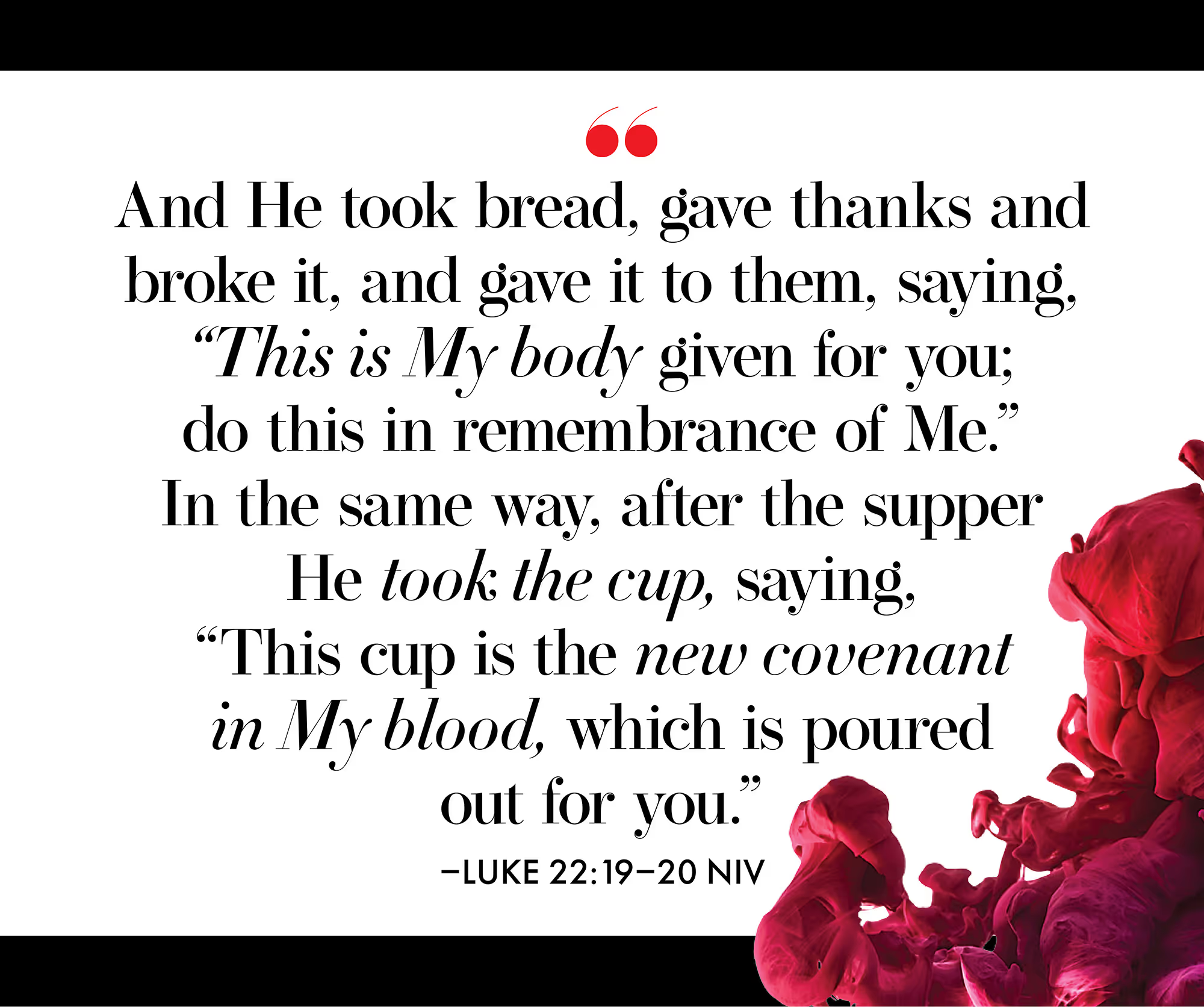
Jesus picked up the bread, gave thanks, handed it to His disciples, and said, “This is my body which is given for you. Do this in remembrance of me.“ And likewise the cup after supper, saying, “This cup which is poured out for you is the new covenant in my blood” (Luke 22:19–20 RSV). Taking the Lord’s Supper with Christian brothers and sisters is a reminder of the fellowship we have with God through Jesus. It is a reminder that Jesus’s blood paid for our sins once and for all.

We take the bread to remember that Jesus’s body was broken for us. We drink of the cup to remember that His blood was poured out for us. Then, just as the disciples did at the Last Supper, we sing a hymn to remind our hearts that our redemption was bought with a price.

More

Stories

No items found.
Read more

More

Faith

Stories

Read more

Related Categories